From NPV to ENPV: Integrating Multiplier Effects into Energy Project Feasibility Assessment
"Advancing Evidence-Based Energy Investment Decisions through Economic Impact Analysis"
Press Release
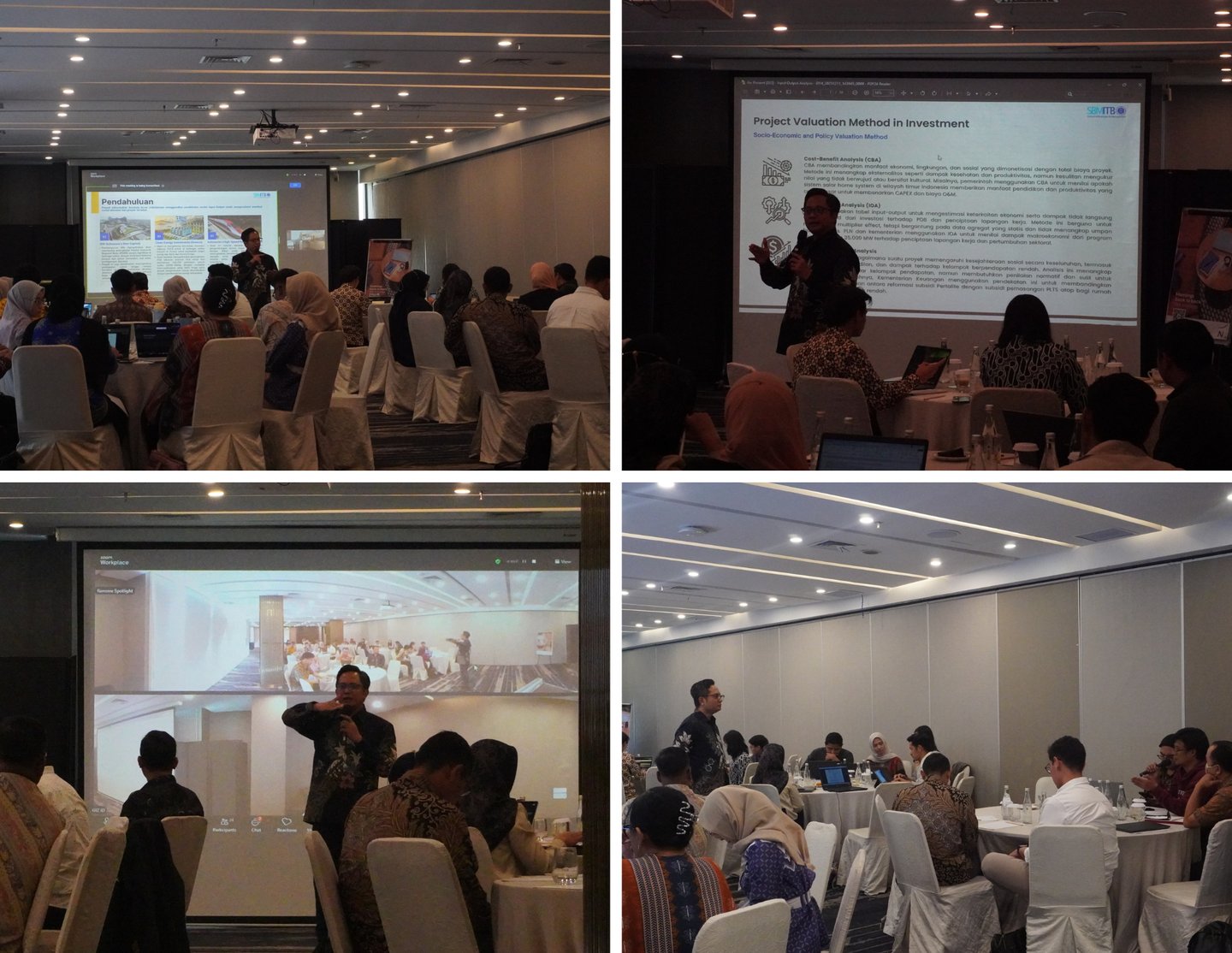
Jakarta, December 12, 2025 – The Sustainable Energy Finance (SEF) Forum – Training Session 3, jointly organized by Badan Perencanaan Pembangunan Nasional (Bappenas) and Deutsche Gesellschaft für Internationale Zusammenarbeit (GIZ) through the CASE for Southeast Asia Programme, convened policymakers, state-owned enterprises, financial institutions, development partners, and research organizations to discuss Multiplier Effects and Quantitative Project Feasibility Assessment. The forum was held on 12 December 2025 in Jakarta and forms part of the SEF Forum capacity-building series on sustainable energy finance.
The session highlighted the importance of moving beyond conventional Net Present Value (NPV) analysis toward Economic Net Present Value (ENPV) as a more comprehensive framework for assessing energy investments. ENPV integrates multiplier effect analysis to capture broader economic impacts, including employment generation, local value creation, and inter-sectoral linkages dimensions that are critical for aligning energy projects with national development objectives and public policy priorities.
As part of the technical program, participants were introduced to quantitative methodologies for measuring multiplier effects in renewable energy projects, particularly within the power sector. These approaches enable decision-makers to assess not only the financial viability of projects, but also their contribution to economic growth, fiscal efficiency, and structural transformation. The discussion underscored that energy transition investments are not merely technological or financial undertakings, but strategic development interventions with wide-ranging socioeconomic spillovers.
The forum also addressed Indonesia’s broader energy transition context, including the government’s targets under the RPJMN 2025–2029 and the PLN Electricity Supply Business Plan (RUPTL) 2025–2034, which anticipate substantial private-sector participation and large-scale investment requirements. In this setting, ENPV-based appraisal was emphasized as a critical tool to support evidence-based policymaking, prioritize high-impact projects, and strengthen coordination between fiscal policy, energy planning, and sustainable finance mechanisms.
The multiplier effect module was delivered by Ir. Dzikri Firmansyah Hakam, S.T., Pg.Dip., M.Sc., Ph.D., Executive Director of Institute for Energy, Economics & Finance (IEEF) and faculty member at SBM ITB. The session demonstrated how ENPV-based feasibility assessment can complement traditional financial indicators such as IRR, DSCR, and LCOE by embedding economic impact considerations into project evaluation and investment decision-making processes.
Through its participation and technical contribution, IEEF reaffirmed its commitment to promoting evidence-based approaches that integrate energy, economic, and financial perspectives. By advancing the application of ENPV and multiplier effect analysis, IEEF supports the development of more robust, transparent, and development-oriented frameworks for sustainable energy policy and investment in Indonesia
Lombok Tengah — SBM ITB bersama IEEF, UPI, dan Unpad melaksanakan program pengabdian masyarakat di Desa Mertak untuk memperkuat literasi keuangan dan mendorong pemberdayaan ekonomi desa di sekitar kawasan Mandalika....Read more
Copyright ©2025 IEEF all right reserved.
Empowering Sustainable Growth with Economic and Financial Insight
Jl. Ganesa Lb. Siliwangi, Kecamatan Coblong, Kota Bandung, Jawa Barat.


ieef@ieef.or.id